

Sports betting has never been more accessible for American bettors, but the sheer number of wager types available can make even experienced players second-guess themselves. Walk into any sportsbook app and you'll find moneylines, spreads, parlays, props, teasers, futures, and live bets all competing for your bankroll. Picking the wrong type for your skill level or situation is one of the fastest ways to bleed money. This guide cuts through the noise, explains every major wager type in plain terms, and shows you exactly where AI-powered models are changing the math, especially for prop bets and fantasy sports platforms.
Table of Contents
- How to assess sports bet types
- The main types of sports bets explained
- A closer look at prop bets and their variations
- Wager type comparison chart
- What experts won't tell you about picking wager types
- Level up with sports AI insights
- Frequently asked questions
Key Takeaways
| Point | Details |
|---|---|
| Know your options | Understanding the main wager types helps you make smarter bets. |
| AI gives a prop edge | Advanced modeling can help you outperform the odds, especially with player props. |
| Match risk to style | Stick to straightforward bets if you're new, or try props/futures if you want more excitement and challenge. |
| Avoid the parlay trap | Big parlay wins are rare; experts suggest careful use of these high-risk bets. |
| DFS and prop betting overlap | AI-powered analysis benefits both daily fantasy and prop bet strategies. |
How to assess sports bet types
Now that we've set the stage, let's lay out how to approach all the options you'll encounter as a bettor. Not every wager type is created equal, and the best choice depends on four key factors you should evaluate before placing a single dollar.
Risk and reward go hand in hand. Simple bets like moneylines carry lower variance, meaning your results won't swing wildly from week to week. High-payout options like parlays or same-game parlays can look attractive, but the probability of winning drops sharply with every leg you add. Understanding how much you could lose is just as important as knowing what you could win.
Complexity is the second factor. Some bets require only a single decision, while others demand you correctly predict multiple outcomes simultaneously. A beginner who jumps straight into five-leg parlays without understanding how each leg affects overall probability is essentially playing a lottery ticket dressed up as a sports bet.
Skill versus luck matters enormously. Certain wager types reward research, historical analysis, and situational awareness far more than others. This is where advanced wager types like player props separate the casual bettor from the disciplined one. When you bring real data to the table, you can find genuine edges.
Compatibility with AI models and fantasy platforms is the fourth dimension, and it's increasingly important. Core wagers like moneyline, spread, and totals suit beginners well, but props and parlays for advanced bettors with sport knowledge benefit enormously from AI modeling, especially in fantasy platforms like DraftKings Pick6 where the model processes stats and game factors at scale.
Here's a quick checklist before you choose a wager type:
- What is my realistic win probability for this bet?
- How much research or data do I have access to?
- Does this bet type match my current bankroll size?
- Am I using an AI tool or manual research to find value?
- Is this a single-game focus or a long-term outlook?
Pro Tip: Always match your wager type to your information advantage. If you have deep knowledge of a specific player's recent usage trends, a player prop is smarter than a moneyline where dozens of other variables dilute your edge.
The main types of sports bets explained
With those decision-making criteria in mind, let's examine what each betting type actually offers with plain-language definitions and their key pros and cons.
Sports gambling wagers for US bettors include nine primary categories: moneyline, point spread, totals/over-under, parlays, props, teasers, futures, round robins, and live/in-play betting. Here's what each one means in practice.
Moneyline is the simplest bet you can make. You pick who wins the game, full stop. If you bet the Kansas City Chiefs at -150, you need to risk $150 to win $100. If you back the underdog at +130, a $100 bet returns $130 profit. No spreads, no margins, just winner takes all.

Point spread adds a margin of victory requirement. The favorite must win by more than the spread, while the underdog must either win outright or lose by less than the spread. This levels the playing field and creates roughly 50/50 propositions on both sides, which is why it's the most popular bet type in football and basketball.
Totals (over/under) removes the winner question entirely. You bet on whether the combined score of both teams will go over or under a set number. This is popular because it keeps you invested in both teams throughout the game without needing to root for one side.
Parlays combine two or more individual bets into one ticket. All legs must win for the parlay to pay out. The appeal is obvious: a $20 four-team parlay can return several hundred dollars. The trap is that each additional leg multiplies the difficulty, not just the payout. Parlay and teaser strategies require careful construction to avoid common mistakes.
Teasers let you adjust point spreads in your favor across multiple games, but in exchange for reduced payouts. A six-point NFL teaser, for example, lets you move each spread by six points, which is a meaningful advantage in a sport where field goals decide games.
Futures are long-term bets on season-level outcomes, like which team wins the Super Bowl or which player wins MVP. They offer big payouts but tie up your money for months and carry significant uncertainty.
Round robins automatically generate multiple parlays from a group of teams you select. Instead of one large parlay, you spread your action across smaller combinations, which reduces variance while maintaining upside.
Props focus on specific events within a game rather than the final outcome. We'll cover these in depth in the next section.
Live/in-play betting lets you place wagers while the game is happening, with odds updating in real time based on what's occurring on the field or court.
| Bet type | Complexity | Payout potential | Skill impact |
|---|---|---|---|
| Moneyline | Low | Low to medium | Medium |
| Point spread | Low | Medium | Medium |
| Totals | Low | Medium | Medium |
| Parlays | Medium | High | Low to medium |
| Teasers | Medium | Medium | Medium |
| Futures | Low | High | Medium |
| Props | Medium to high | Medium to high | High |
| Round robins | High | High | Medium |
| Live betting | High | Medium to high | High |
Pro Tip: If you're new to sports betting, spend your first month exclusively on moneylines and totals. Master reading odds and understanding implied probability before adding complexity.
A closer look at prop bets and their variations
Once you grasp the main types, it's time to spotlight prop bets, a category where skill and smart modeling matter more than ever.
Prop bets break down into four subcategories: player props, game props, team props, and novelty props. Each one targets a different slice of the action.
- Player props focus on individual statistics. How many passing yards will Patrick Mahomes throw? Will LeBron James score over or under 27.5 points? These bets live and die by individual performance, usage rates, matchup quality, and game script.
- Game props target specific events within a game. Which team scores first? Will there be a safety? These are less about individual stats and more about situational football or basketball tendencies.
- Team props track collective statistics. Will the Dallas Cowboys rush for more than 120 yards as a team? Will the Golden State Warriors hit more than 14 three-pointers?
- Novelty props cover entertainment-level outcomes, like the Super Bowl coin toss result or the length of the national anthem. These are purely for fun and carry no skill edge.
The real opportunity for disciplined bettors sits in player props. This is where AI modeling earns its keep. A good model doesn't just look at season averages. It factors in defensive rankings against specific positions, weather conditions for outdoor games, pace of play, injury reports, and historical performance in similar matchups.
"Player prop unders beat closing lines more often than overs, with NFL rushing overs winning less than 50% of the time over the past three seasons." This expert insight from ESPN's NFL betting guide reflects a pattern that sharp bettors have exploited for years. Sportsbooks consistently shade player prop lines toward the over because recreational bettors prefer rooting for more action. The under is often the smarter play.
Live betting within the props category is its own beast. Odds shift in seconds based on game flow, and the edge goes to bettors who can process information quickly and act before the market corrects. This is precisely where AI tools that monitor real-time data streams provide a genuine advantage over manual research.
Pro Tip: When betting player props, always check if a key player is listed as questionable or limited in practice. A running back at 75% health may still be listed at the same rushing yards total as a fully healthy week, creating real value on the under.
Wager type comparison chart
Now that you know the details, let's put everything side by side so you can see clearly how the main bet types compare for practical use.
One of the most important things to understand is where the house edge sits for each bet type. Parlays carry a high house edge and experts generally recommend limiting their use, while props carry a higher vig of around 8 to 10% but reward bettors who bring deep knowledge or AI-assisted analysis. Fantasy sports props in DFS and Pick'em formats blend skill and luck in a way that separates them from traditional sportsbook wagers.
| Bet type | House edge | Ideal user | AI/fantasy fit | Bankroll risk |
|---|---|---|---|---|
| Moneyline | 4-5% | Beginners | Low | Low |
| Point spread | 4-5% | Beginners to intermediate | Low | Low |
| Totals | 4-5% | All levels | Medium | Low |
| Parlays | 15-30%+ | Entertainment only | Low | High |
| Teasers | 6-8% | Intermediate | Low | Medium |
| Futures | 10-20% | Long-term thinkers | Low | Medium |
| Player props | 8-10% | Advanced/AI users | Very high | Medium |
| Team props | 8-10% | Advanced | High | Medium |
| Live betting | Varies | Advanced/AI users | Very high | Medium to high |
The table makes one pattern obvious: the bets with the highest potential payouts also carry the steepest house edge. Parlays are the clearest example. A four-team parlay at true odds should pay around 15 to 1, but most sportsbooks pay closer to 12 to 1. That gap is pure profit for the book.
Player props and live betting stand out as the categories where skill and AI tools can genuinely shrink the house edge. When your model identifies a line that's mispriced by even 3 to 5%, that's a meaningful long-term advantage.
What experts won't tell you about picking wager types
All the comparisons above are useful, but there's one uncomfortable truth that deserves emphasis before you start placing your bets.
Most bettors lose money not because they pick the wrong teams but because they pick the wrong bet types for their actual skill level. The sports betting industry is built on the fantasy that parlays are exciting and accessible. And they are exciting. But excitement is not a strategy.
The bettors who consistently profit over long periods are almost universally focused on one of two approaches. The first is grinding out small edges on simple wagers, moneylines and spreads, with strict bankroll discipline and a clear understanding of closing line value. The second is systematically modeling props, particularly player props, where information asymmetry still exists and where AI models for sports betting can process variables that no human can track manually.
Here's the uncomfortable part: most casual bettors do neither. They chase parlays for the big hit, mix in random props based on gut feel, and wonder why their bankroll shrinks every month. The house edge on a five-team parlay is not a minor headwind. It's a wall.
The contrarian insight is this: the most boring-looking bet on the board is often the most profitable. A single-game player prop backed by a solid model, placed at the right line, beats a flashy parlay almost every time over a large sample size. Discipline compounds. Lottery tickets don't.
AI tools change the calculus specifically for props and live betting because those markets are less efficient than spread or moneyline markets. Sportsbooks spend enormous resources setting spread lines correctly. Player prop lines for a third-string running back's receiving yards? That's where the inefficiencies live.
Level up with sports AI insights
Ready to put these strategies and insights into action? Take your betting game further with smarter, AI-powered support.
Understanding bet types is only half the battle. The other half is having the right tools to find value within those bet types before the market corrects. The Atlas Sports AI platform is built specifically for bettors who want to move beyond guesswork on props and straight bets. It models player performance, tracks line movement, and surfaces edges across fantasy sports formats like DFS Pick'em contests.
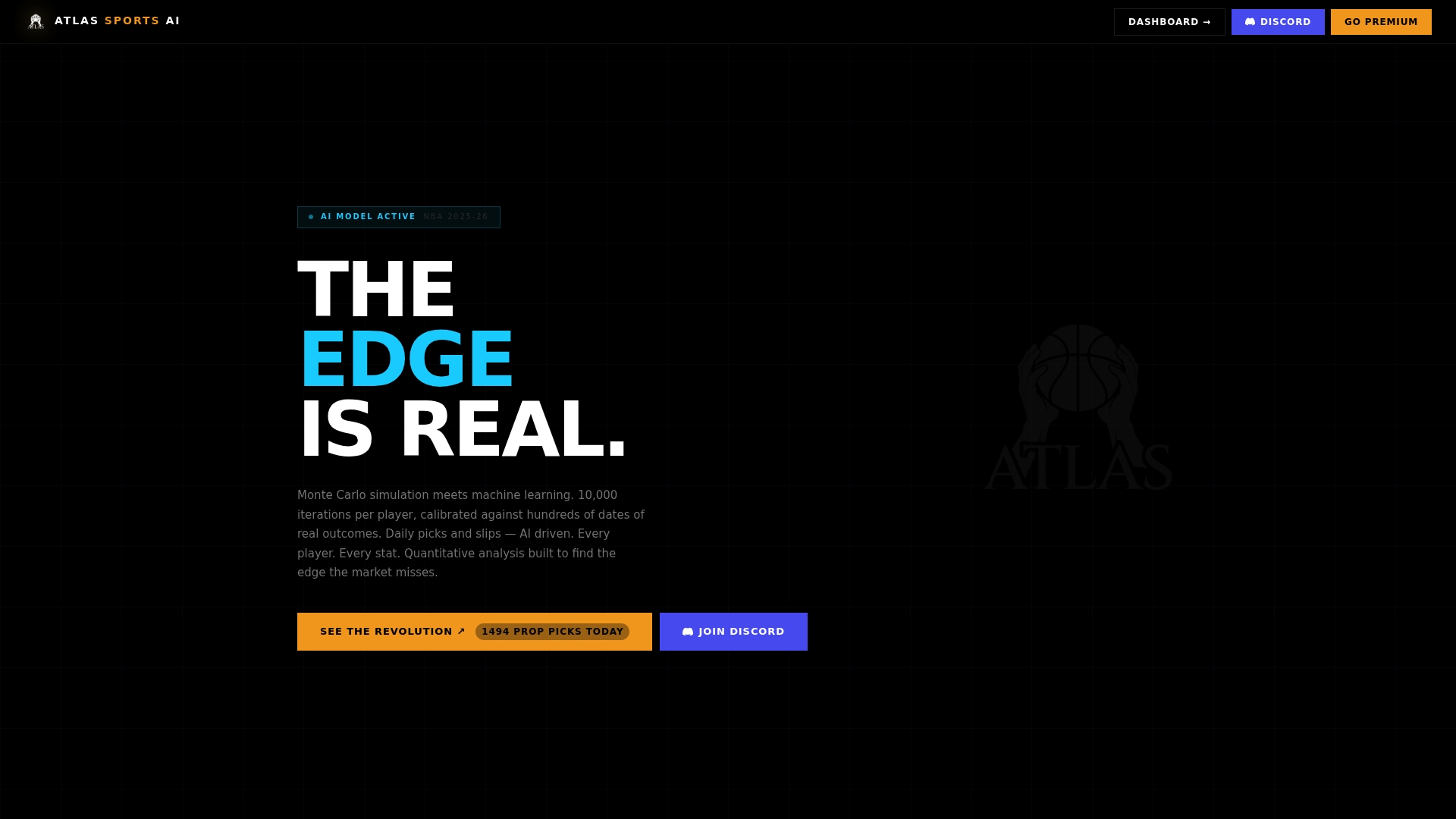
Whether you're building a disciplined prop betting strategy or looking to sharpen your DFS lineup decisions, Atlas Sports AI delivers real-time analysis that manual research simply can't match. The platform gives you data-driven picks, model outputs, and tools designed for the kind of systematic approach that actually moves the needle on your win rate over time. Stop betting on instinct and start betting on information.
Frequently asked questions
What is the safest type of sports wager for new bettors?
Moneyline, spread, and totals are the most beginner-friendly bets due to their simplicity and lower house edge compared to parlays or props. Start here before adding complexity.
How do prop bets differ from standard wagers?
Props focus on specific events or individual stats within a game, while standard wagers target overall outcomes like who wins or by how much. Player props, game props, team props, and novelty props each target a different layer of the action.
Are parlays worth the risk?
While parlays can yield high payouts, they carry a high house edge and are generally riskier than single bets. Experts recommend limiting parlay use to small entertainment stakes, not core bankroll strategy.
Can AI really give an edge in sports betting?
Advanced AI models improve your chances on prop bets by processing more stats and scenarios than manual research ever could. AI enhances prop edge in fantasy platforms like DraftKings Pick6 by modeling stats and game factors simultaneously.
Which bet types are best for using AI tools?
Player props, team props, and live/in-play bets benefit most from AI analysis because they rely on real-time stats and probability modeling where markets are less efficient than traditional spread or moneyline lines.