

You place a bet, the team you picked wins, and somehow you still lose money. Sound familiar? That scenario plays out every week for bettors who haven't fully cracked the logic of sports gambling spreads. The spread isn't just a number next to a team's name. It's a precisely engineered figure designed to balance action and, if you're not careful, catch you off guard. This guide breaks down exactly how spreads work, how to prepare for analysis, and how pairing that knowledge with an AI betting model can sharpen your decision-making and reduce costly mistakes.
Table of Contents
- Understanding sports gambling spreads
- Preparing to analyze spreads with an AI model
- Step-by-step guide to reading and evaluating spreads
- Common mistakes and troubleshooting
- A fresh perspective on beating the spread
- Elevate your betting strategy with AI insights
- Frequently asked questions
Key Takeaways
| Point | Details |
|---|---|
| Half-point hook advantage | A half-point in spreads removes the chance of a tie, resulting in clear wins or losses for bettors. |
| Model divergence | When your AI's prediction varies from the market, investigate before betting for higher confidence. |
| Market efficiency | Finding an edge is harder as markets adapt quickly, so timing and specialized niches are key. |
| Preparation matters | Having the right data, updated info, and model output is fundamental for successful spread analysis. |
| Avoid common mistakes | Check for line moves and hooks to prevent avoidable betting losses. |
Understanding sports gambling spreads
Solving the confusion starts with grasping the basics and nuances of sports betting spreads.
A betting spread, also called the point spread, is a margin set by a sportsbook to level the playing field between two unevenly matched teams. The favorite is the team expected to win, shown with a minus sign (for example, -6.5). The underdog is the team expected to lose, shown with a plus sign (for example, +6.5). When you bet the favorite, they need to win by more than 6.5 points for you to cash. When you bet the underdog, they need to either win outright or lose by fewer than 6.5 points.
Now here's where a lot of bettors get tripped up: the hook. The hook refers to the half-point added to a spread, like -6.5 instead of -6. Why does it matter? Because the half-point hook eliminates pushes. A push happens when the final margin exactly matches the spread, which results in your stake being returned. Sportsbooks use half-points to ensure every bet has a definitive winner or loser. That extra half-point shifts the risk entirely onto you.
Whole-number spreads vs. spreads with a hook
| Spread type | Example | Push possible? | Risk level |
|---|---|---|---|
| Whole number | -7 | Yes, if margin = 7 | Lower (push refunds stake) |
| With hook | -7.5 | No | Higher (no refund) |
| With hook | -3.5 | No | Higher (no refund) |
| Whole number | -3 | Yes, if margin = 3 | Lower |
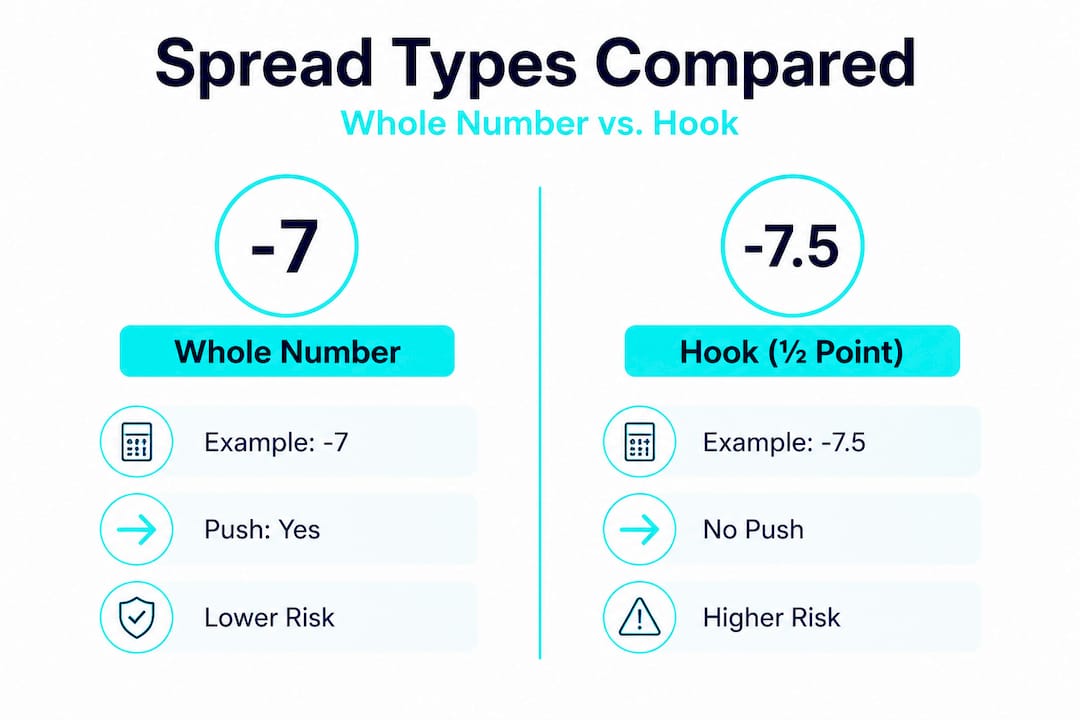
The table makes it clear: whole-number spreads carry a small safety net. Spreads with a hook remove that net entirely. In the NFL, spreads of -3 and -7 are historically significant because field goals and touchdowns are the most common scoring increments. When you see -3.5 or -7.5, the sportsbook is deliberately pushing you off those key numbers.
Key concepts to remember about how spreads are set:
- Sportsbooks use a combination of power ratings, injury data, weather forecasts, and public betting patterns to set the opening line
- Lines shift based on where the money flows, not just who the better team is
- Sharp bettors (professionals) move lines quickly, sometimes within minutes of opening
- The closing line, the final spread before game time, is often the most accurate reflection of true probability in efficient sports betting markets
Pro Tip: Always check if the spread includes a half-point before placing your bet. A -7 and a -7.5 look similar but carry very different risk profiles, especially in football where a 7-point margin is extremely common.
Preparing to analyze spreads with an AI model
Once spreads are understood, successfully reading them requires methodical preparation that enables meaningful analysis.

You wouldn't show up to a job interview without researching the company. The same logic applies to betting spreads. Walking in with just a gut feeling and a sportsbook app isn't a strategy. It's a gamble in the worst sense of the word. Preparation is what separates recreational bettors from those who actually build an edge over time.
Here's what you need before you start evaluating any spread with an AI model:
- Sportsbook lines from multiple books: Spreads can vary by half a point or more across books. Shopping lines is one of the simplest ways to gain a small but real edge.
- AI model projections: Your model's predicted margin of victory for each team, based on current data.
- Injury and roster reports: A star player ruled out hours before tip-off can swing a spread by 2 to 4 points.
- Line movement history: Knowing where the line opened and where it sits now tells you a lot about sharp action.
- Weather data (for outdoor sports): Wind and precipitation affect scoring, especially in football and baseball.
Preparation steps and tools
| Step | Action | Tool or source |
|---|---|---|
| 1 | Pull opening and current spread | Sportsbook apps, odds aggregators |
| 2 | Run AI model projection | Your AI betting model output |
| 3 | Check injury reports | Official team sites, beat reporters |
| 4 | Review line movement | Odds tracking platforms |
| 5 | Compare model vs. market | Side-by-side analysis |
| 6 | Set final bet decision | Based on edge size and confidence |
One of the most important habits you can build is updating your data as close to game time as possible. Line movement and game-day information affect how you should evaluate spreads in a major way. A model projection built on yesterday's data might be completely outdated if a key player is unexpectedly scratched this morning.
Using model projections effectively means more than just looking at the number. If your model says Team A wins by 9 and the spread is -6.5, that's a 2.5-point edge in your favor. But the quality of that edge depends entirely on the freshness and accuracy of your inputs. Garbage in, garbage out. Make sure your model is working with the most current data available before you commit any money.
Step-by-step guide to reading and evaluating spreads
With your prep complete, here's how to execute spread analysis for smart wagering decisions.
This is where preparation turns into action. Following a consistent process keeps emotion out of the equation and forces you to evaluate each bet on its own merits.
-
Identify the spread and which team you're evaluating. Note the favorite (minus sign) and underdog (plus sign). Write down the exact number, including whether there's a hook.
-
Pull your AI model's projected margin. This is your baseline. It represents what the model believes the actual outcome will be, independent of public opinion or sportsbook influence.
-
Calculate the divergence. Subtract the spread from your model's projected margin. A large gap between the two is a potential signal. For example, if the spread is -4.5 and your model projects a 9-point win for the favorite, that's a 4.5-point divergence worth investigating.
-
Check recent line movement. Has the spread moved toward or away from your model's projection? If sharp money is moving in the same direction as your model, that's a reinforcing signal. If it's moving against your model, dig deeper before acting.
-
Account for game-day factors. Injuries, lineup changes, weather updates, and travel schedules can all shift the true probability. Re-run or adjust your model inputs if significant new information is available.
-
Make a final decision with a clear rationale. Don't bet because the number looks good. Bet because you have a specific, data-backed reason to believe the market is mispriced.
-
Record your bet and reasoning. Keeping a log is how you identify patterns in your own decision-making over time.
The critical insight here is that divergence between AI model projection and market line is a signal to investigate, not a guaranteed green light to bet. Markets are often right. When your model disagrees with the market, the question isn't "should I bet this?" It's "why does this gap exist, and do I have information the market doesn't?"
Pro Tip: Don't bet mechanically. When your model disagrees with the market, treat it as a trigger for further investigation, not instant action. The best bets come from understanding why the edge exists, not just that it exists.
Knowing how to find profitable spreads consistently requires this kind of disciplined, iterative approach. It's a process, not a one-time calculation.
Common mistakes and troubleshooting
Even a solid process can go awry. Here's what bettors need to watch out for and how to recover.
The most experienced bettors still make mistakes. The difference is they've built systems to catch errors before they become expensive habits. Here are the most common pitfalls:
- Ignoring the hook: Betting a whole-number spread without considering the push scenario, or betting a hooked spread without understanding the increased risk.
- Using stale data: Running model projections without updating for same-day injury reports, lineup changes, or weather.
- Chasing line movement without context: Seeing a line move and assuming it means something without understanding whether it's sharp money or public overreaction.
- Overconfidence in a single model: No model is perfect. Treating AI output as gospel rather than one strong input among several is a recipe for overexposure.
- Skipping post-game review: Not verifying results, including pushes and near-misses, means you're missing feedback that could improve future decisions.
After every game, take five minutes to review what happened. Did the spread hold? Was there a push? Did your model's projection align with the actual margin? This feedback loop is where real learning happens.
"Some bettors argue mainstream edges are harder to find because lines move quickly with sharp and algorithmic money, making it nearly impossible to consistently beat closing lines in popular markets."
That quote reflects a real concern in the betting community. Market efficiency skepticism is growing, and for good reason. In high-volume markets like NFL primetime games, lines are sharp almost immediately. The edges that do exist tend to be smaller, shorter-lived, and more dependent on timing and niche expertise.
The expert shortcut here is specialization. Bettors who focus on a specific conference, a specific sport, or even a specific type of prop bet tend to outperform those who spread their attention across every available market. Depth beats breadth when markets are efficient.
A fresh perspective on beating the spread
Let's step back and analyze why today's market demands a deeper, more nuanced strategy than ever before.
Here's something most betting guides won't tell you: the generic "use an AI model and follow the picks" approach is losing its edge fast. Not because AI models are bad, they're actually remarkably powerful. But because everyone has access to similar tools now. When the same projections are widely available, the market absorbs that information quickly, and the edge evaporates.
The bettors who are actually winning in 2026 aren't just using AI. They're using AI better than the next person. That means understanding the model's assumptions, knowing when to trust it and when to override it, and recognizing that a model projection is only as good as the context it's built on.
The real edge now lives in three places: timing, specialization, and real-time reaction. Timing means acting on information before it's priced into the line. Specialization means knowing a specific market so well that you catch mispricing the model might miss. Real-time reaction means having a process that lets you update your analysis quickly when new information hits.
There's also a mindset shift required. Most bettors treat their AI model like a vending machine. Put in the game, get out the pick. That's not how the best users of AI betting insights operate. They treat the model as a starting point for a conversation, not the final answer.
Ask yourself before every bet: is the model's edge real for this specific market and this specific moment? Or is it a theoretical edge that the market has already priced out? If you can't answer that question confidently, the bet isn't ready.
The bettors who thrive long-term are those who combine model discipline with situational awareness. They know when to lean on the data and when to step back and let a game pass. That kind of judgment can't be automated. It has to be developed through experience and honest self-assessment.
Elevate your betting strategy with AI insights
Ready to take your spread analysis further? See how advanced tools can enhance your results.
Understanding spreads is one thing. Having a system that helps you act on that understanding consistently is another challenge entirely. Atlas Sports AI is built for bettors who want to move beyond guesswork and into data-driven decisions that actually hold up over time.
The AI-powered betting platform at Atlas Sports AI gives you model-driven projections, real-time data updates, and prop-focused insights designed to help you identify edges before the market closes them. Whether you're evaluating a spread in the NFL, NBA, or another major league, the platform adapts to market dynamics and helps you time your bets for maximum value. If you're serious about applying the strategies in this guide, Atlas Sports AI is the practical tool that brings it all together.
Frequently asked questions
What does the half-point 'hook' mean in sports betting spreads?
The half-point hook eliminates pushes, ensuring every bet results in a win or a loss rather than a refunded stake. It shifts full risk onto the bettor by removing the possibility of a tie between the final margin and the spread.
How should I react when my AI model disagrees with the current betting spread?
Treat the divergence as a signal to investigate further, not a reason to bet automatically. Check for recent game-day developments that may have shifted the line since your model last ran.
Can sports betting spreads be beaten consistently?
Mainstream edges are difficult to sustain because of efficient markets and rapid line adjustments driven by sharp and algorithmic money. Timing and niche specialization give you the best chance at finding sustainable edges.
What data should I collect before analyzing spreads with an AI model?
Gather sportsbook lines from multiple books, real-time injury reports, line movement history, weather data for outdoor games, and your AI model's current projections for the most complete picture.
What is a 'push' in sports spread betting?
A push occurs when the game's final margin exactly matches the spread, and the stake is returned to the bettor. If the spread includes a hook, a push becomes impossible and bets always result in a win or loss.