
You've spent two hours researching a five-leg PrizePicks entry, cross-referencing box scores and injury reports, only to watch three of your picks bust by halftime. It's a frustrating cycle that most prop bettors know too well. AI-powered tools are changing that equation by processing thousands of data points in seconds, calculating win probabilities, and flagging the picks with the strongest edge. This guide walks you through exactly how to set up, use, and verify AI tools for prop picks on PrizePicks and Underdog so you can bet with more confidence and less guesswork.
Table of Contents
- What you need to start using AI for prop picks
- Step-by-step: Applying AI tools for prop picks
- Verifying results and tracking performance
- Common mistakes and how to avoid them
- A realistic perspective: AI is a tool, not a guarantee
- Take your AI betting picks to the next level
- Frequently asked questions
Key Takeaways
| Point | Details |
|---|---|
| AI enhances prop picks | AI tools streamline data analysis and signal high-value props, but must be used smartly. |
| No guaranteed profits | Even advanced AI models face market variance, so disciplined tracking and skepticism are key. |
| Human oversight is essential | Review news, injury updates, and context manually to complement AI predictions. |
| Track performance transparently | Monitor win rates, ROI, and tool transparency to judge long-term effectiveness. |
What you need to start using AI for prop picks
Before you run any projections, you need the right accounts and tools in place. Think of this as building your workstation before you start the job.
Accounts and platforms first. Sign up for PrizePicks and Underdog Fantasy if you haven't already. Both platforms offer player prop pick'em contests where you predict whether a player goes over or under a set stat line. These are the markets where AI tools deliver the most actionable edges, because the lines are set by the platform rather than sharp sportsbooks, leaving more room for exploitable gaps.
Choosing your AI tool. Three tools stand out for prop pick bettors right now:
- PickLabs (by FantasyLabs): Built specifically for pick'em platforms. PickLabs calculates win probability and a graded edge for each available pick, updating projections in real time for injuries, lineup changes, and weather. It's designed specifically for Underdog, Sleeper, and PrizePicks.
- Rithmm AI: Focuses on NFL and NBA props with hit rates, matchup context, and Smart Signals (called Bolt picks) for high-confidence plays. Pricing starts at $29.99 per month for the Core plan.
- Action Network Playbook: A free AI assistant that compares odds across books, integrates injury and usage context, and helps build parlays. It prioritizes price and edge over raw predictions.
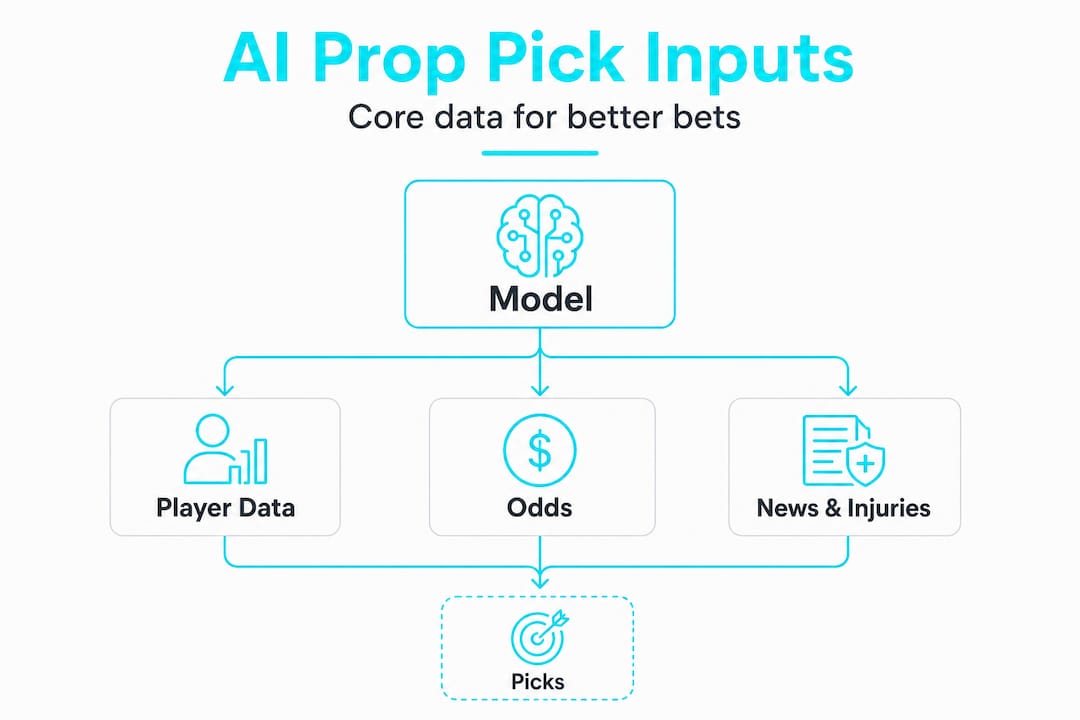
What inputs matter most. Every AI tool is only as good as the data feeding it. You need to understand three core inputs: the sport and prop type you're targeting, current injury and lineup news, and the line itself. A projection without context around a player's minutes restriction or a back-to-back schedule is incomplete. The Atlas Sports AI overview covers how modern models layer these inputs together to generate reliable edges.
Here's a quick comparison of the three tools:
| Tool | Sport coverage | Key feature | Price | Best for |
|---|---|---|---|---|
| PickLabs | NFL, NBA, MLB, NHL | Win probability + graded edge | Subscription | PrizePicks/Underdog focus |
| Rithmm AI | NFL, NBA, NCAAM | Bolt picks (high-confidence) | $29.99/mo Core | High-conviction plays |
| Action Network Playbook | Multi-sport | Odds comparison + parlay builder | Free | Price shopping + context |
Pro Tip: Start with one tool and one sport. Trying to run three platforms across five sports simultaneously leads to analysis paralysis and sloppy picks. Master the workflow on, say, NBA props before expanding.
Step-by-step: Applying AI tools for prop picks
Now that your toolkit is ready, let's walk through exactly how to make your picks using AI from start to finish.

Step 1: Pick your sport and prop type. Not all props are created equal. Points and rebounds in the NBA, passing yards in the NFL, and strikeouts in MLB tend to have the most data available for AI models to work with. Avoid obscure props like "first basket scorer" where sample sizes are too small for reliable projections. Narrow your focus to two or three prop types per session.
Step 2: Generate projections and scan for edges. Open your AI tool and pull up the available picks for the day. In PickLabs, you'll see a win probability percentage and a color-coded edge grade for each prop. In Rithmm, look for Bolt picks, which the platform flags as its highest-confidence plays. User-reported results show 36 units of profit in February across NCAAM and NBA props, and a 27-3 record on NFL playoff Bolts, though individual results will vary significantly.
Step 3: Cross-check news and context. This is where most bettors skip a critical step. AI models update for known injuries and lineups, but breaking news moves faster than any model refresh cycle. Before locking in a pick, spend two minutes checking beat reporters on X (formerly Twitter) and the official injury report. A player listed as questionable who ends up playing 22 minutes instead of 35 can flip a points prop from a strong over to a clear under.
Step 4: Interpret signals and choose picks with the highest edge. Action Network's Playbook AI integrates real-time data for props and same-game parlays, focusing on price and edge rather than just raw predictions. Use it to confirm that the line you're targeting is actually off-market, not just a projection that happens to point in one direction.
Here's a summary of the step-by-step workflow:
| Step | Action | AI feature used | Key signal |
|---|---|---|---|
| 1 | Select sport and prop type | Prop filter | Data availability |
| 2 | Generate projections | Win probability | Edge grade |
| 3 | Cross-check news | Injury/lineup updates | Model freshness |
| 4 | Select highest-edge picks | Smart Signals / Bolt picks | Confidence tier |
Pro Tip: Before placing any entry, review the tool's historical hit rate for that specific prop type. A tool might show 68% win probability on NBA rebounds but only have a 51% actual hit rate on that market historically. Backtested results tell a more honest story than single-day projections.
You can also explore AI tools for prop picks to see how different model architectures handle specific sports and prop categories, which helps you calibrate your confidence before committing real money.
Verifying results and tracking performance
After making picks, how do you know if you're really getting value from AI? Let's break down the numbers and what they mean.
Track the right metrics. Win rate alone is misleading on pick'em platforms. What matters is your overall return on investment (ROI), measured in units gained or lost relative to your entry fees. A bettor going 55% on two-leg entries might still be losing money if they're chasing bad lines. Track every entry: date, sport, prop type, AI tool used, edge grade, result, and units won or lost. A simple spreadsheet works fine.
Understand variance. Even a tool with genuine edge will go through cold stretches. The key question is whether your results over 100 or more picks are trending positive or flat. Short-run results, good or bad, tell you almost nothing. A 10-pick winning streak feels great but is statistically meaningless.
The uncomfortable benchmark data. Here's something the marketing pages won't highlight: benchmarks show LLMs lose money in real sports betting environments. The KellyBench study found that all tested models lost money over the 2023-24 EPL season, with the best performer still averaging -7.9% ROI. That doesn't mean specialized prop tools are worthless, but it does mean you should demand transparency from any tool you pay for.
On the positive side, ML models for basketball achieve impressive accuracy in controlled studies, with MLP models hitting 98.9% and random forest models at 93.8% in a systematic review of 34 studies. The catch is that these models predict game outcomes, not individual player props, so real-world prop accuracy is lower. Use these numbers as context, not as a promise.
Key metrics to track for tracking AI betting performance:
- Win rate: Percentage of picks that hit
- ROI: Net units won divided by total entries
- CLV (closing line value): Whether your picks beat the closing line, a strong indicator of real edge
- Edge accuracy: How often the AI's projected edge actually materializes
Pro Tip: Keep a separate log for picks where you overrode the AI's recommendation based on your own news research. Over time, this tells you whether your human judgment is adding or subtracting value from the model's baseline.
Common mistakes and how to avoid them
Even the best tools can lead you astray if you don't know what to look out for. Here's how to stay sharp and avoid costly errors.
"AI excels at ingesting vast data including stats, injuries, weather, and matchups for projections and edges, but it requires human oversight for breaking news. Custom models add nuance that generic tools miss entirely."
That quote captures the core tension every prop bettor faces. The tool does the heavy lifting on data, but you still need to be in the loop on real-world context.
The most common mistakes and how to fix them:
-
Trusting AI blindly without checking injury or news context. A model that updated at 9 a.m. doesn't know about the ankle tweak a player reported in the 2 p.m. shootaround. Always do a quick manual news check before locking picks. PickLabs updates for injuries and lineups, but no tool refreshes in real time at every moment.
-
Choosing picks based on predictions alone, ignoring price and edge. A projection that says a player will score 22 points means nothing if the line is set at 21.5 and the platform's juice makes it a negative expected value play. Always factor in the edge, not just the direction of the projection.
-
Believing hype without understanding variance. Social media is full of screenshots showing 10-leg parlays that hit. What you don't see are the 40 misses that came before. Action Network's Playbook explicitly warns against black-box tools that show cherry-picked results without transparent methodology.
-
Using too many tools simultaneously. When three different AI tools give you three different signals on the same prop, you end up picking the one that confirms what you already wanted to bet. That's not AI-assisted betting, that's confirmation bias with extra steps.
-
Ignoring bankroll management. Even a tool with genuine edge will cause you to go broke if you're sizing entries too large. Keep individual entries to 1-3% of your total bankroll, regardless of how confident the AI signal looks.
A realistic perspective: AI is a tool, not a guarantee
Here's the uncomfortable truth that most AI betting content glosses over: the market is efficient enough that no tool, no matter how sophisticated, produces consistent profits without discipline and judgment on your end.
The bettors who actually win long-term with AI tools aren't the ones who find the magic algorithm. They're the ones who use AI to eliminate the noise, narrow their focus to the highest-edge spots, and then apply human judgment to filter out the picks where context doesn't support the model's projection. That combination is where real edge lives.
Black-box models are a red flag. If a tool can't explain why it's recommending a pick, how it calculates its edge, or what its historical accuracy looks like by sport and prop type, you're flying blind. Transparency isn't just a nice feature. It's the only way to know whether you're getting genuine value or just paying for a fancy random number generator.
The other thing worth saying plainly: variance will test you. You'll have weeks where every AI pick misses and weeks where everything hits. Neither tells you whether the tool is working. Only a large sample of tracked results, 200 picks or more, gives you a statistically meaningful read on whether you have real edge. Most bettors quit or switch tools after 20 picks, which means they never actually find out.
The bettors who use AI sports betting insights most effectively treat the tool as a research assistant, not a decision-maker. They let the model surface the best candidates, then apply their own knowledge of the sport, the player, and the situation to make the final call. That's a sustainable process.
Take your AI betting picks to the next level
If you're serious about turning AI-assisted research into consistent, disciplined prop betting, having the right platform behind you makes a real difference.
Atlas Sports AI is built specifically for prop bettors on platforms like PrizePicks and Underdog. The model delivers transparent win probabilities, edge grades, and prop-specific projections that update with real-time injury and lineup data. Whether you're just getting started or looking to sharpen a process that's already working, Atlas Sports AI gives you the tools to make smarter, faster, and more confident picks. Sign up, explore the demo picks, and see how a purpose-built AI model changes the way you approach your next entry.
Frequently asked questions
How accurate are AI tools for sports prop picks?
Accuracy varies significantly by sport, prop type, and model design. ML models for basketball show up to 98.9% accuracy in controlled studies, but real-world prop accuracy is lower because game-outcome models don't directly translate to individual player stat lines.
Do AI-generated gambling picks guarantee profits?
No tool guarantees profits, and benchmarks show LLMs lose money on average in live betting environments, with the best performers still averaging -7.9% ROI. Consistent profitability requires human oversight, disciplined bankroll management, and a large sample size.
What features should I look for in an AI betting tool?
Prioritize transparent win probability, real-time injury and news integration, and clear edge signals over raw predictions. Action Network's Playbook is a good example of a tool that focuses on price and edge rather than just directional picks.
How can I avoid common pitfalls when using AI for gambling picks?
Always manually check injury reports and breaking news before locking picks, because PickLabs and similar tools update for known information but can't catch real-time developments. Combine model signals with your own contextual judgment for the best results.